Biochar carbon dioxide removal (CDR) projects are often presented as a mature and scalable pathway for durable carbon sequestration. In practice, implementation remains constrained by a series of technical, economic, and institutional challenges. These constraints do not invalidate the pathway. They define its current limits and determine which projects achieve credibility in regulated and voluntary carbon markets.
Biochar quality and carbon permanence are directly influenced by feedstock composition. Biomass streams differ widely in moisture content, ash fraction, lignin concentration, and contaminant load. Forestry residues, agricultural byproducts, and organic waste each introduce distinct process dynamics.
This heterogeneity complicates standardization. A biochar production equipment calibrated for one biomass type may experience yield degradation or unstable thermal profiles when inputs shift. Feedstock inconsistency therefore becomes a structural risk rather than an operational inconvenience.
Carbon removal projects require multi-year, often multi-decade, continuity. Securing sufficient biomass volumes without inducing indirect land-use change or ecological degradation is nontrivial. Seasonal availability and competing demand from bioenergy, pulp, and construction sectors further constrain supply.
Traceable sourcing and conservative procurement assumptions are essential, yet they increase transaction complexity and cost.
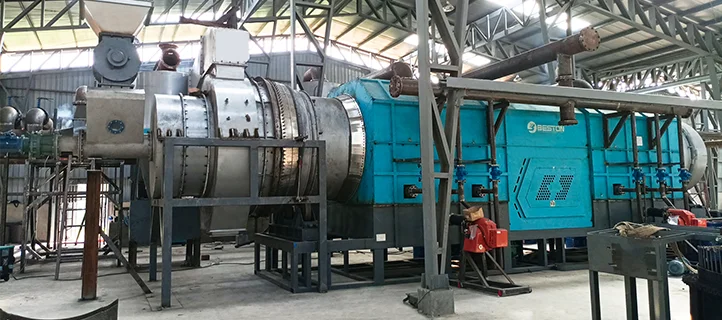
The permanence of carbon stored in biochar depends heavily on pyrolysis temperature, residence time, and heating rate. Suboptimal conditions result in char with higher volatile content and lower resistance to oxidation.
Achieving stable, repeatable thermal regimes at industrial scale remains challenging. Temperature gradients, reactor fouling, and feedstock inconsistency introduce variance that must be tightly managed to meet durability thresholds imposed by carbon credit standards.
Carbon stability is inferred through proxies such as H/C ratios, O/C ratios, or laboratory oxidation tests. These indicators are imperfect. They simplify complex degradation pathways into discrete metrics.
The absence of direct, long-term empirical data forces registries to rely on conservative assumptions, reducing credited removal volumes and weakening project economics.
Measurement, reporting, and verification (MRV) frameworks for biochar CDR require mass balance accounting across feedstock input, char output, and byproduct streams. Small errors propagate across the system.
Accurate quantification demands frequent sampling, laboratory analysis, and third-party verification. These requirements disproportionately affect smaller projects, where fixed MRV costs consume a significant share of revenue.
Emerging digital MRV architectures promise automation and transparency. However, integration with industrial control systems is uneven. Data gaps, sensor drift, and inconsistent calibration undermine confidence.
Without robust digital infrastructure, projects struggle to scale beyond pilot capacity while maintaining verification credibility.
Industrial-scale biochar systems require substantial upfront investment in reactors, emission control, material handling, and monitoring equipment. Returns are backloaded, contingent on credit issuance and sale.
Delays in verification or market downturns expose developers to liquidity risk. Traditional project finance structures are often ill-suited to this revenue profile.
Biochar CDR projects typically rely on carbon credit revenue to achieve commercial viability. Demand is concentrated among a limited set of corporate buyers with evolving procurement criteria.
Price volatility and shifting buyer preferences introduce uncertainty. Projects designed around optimistic price assumptions face stranded asset risk if market sentiment shifts.
Multiple carbon registries offer biochar methodologies, each with distinct assumptions, eligibility criteria, and durability horizons. Navigating these differences requires specialized expertise.
Misalignment between methodologies complicates credit fungibility and reduces liquidity. Developers must often commit to a single registry early, locking in both benefits and constraints.
Regulatory scrutiny of carbon removal claims is intensifying. Standards that are acceptable today may be revised as scientific understanding improves.
Projects lacking adaptive capacity risk retroactive downgrading of credits or exclusion from future compliance markets.
Biochar CDR projects are evaluated not only on carbon removal but also on co-impacts. Air emissions, water use, and residue handling attract regulatory attention.
Failure to adequately manage these dimensions undermines social license to operate and can delay permitting or trigger enforcement actions.
Even when environmental performance is strong, local opposition can emerge due to perceived risks or competing land-use priorities. Transparent engagement and benefit-sharing mechanisms are increasingly necessary.
These social dynamics add layers of complexity beyond technical design.
Performance demonstrated at pilot scale does not automatically translate to industrial reliability. Heat transfer limitations, material wear, and maintenance demands increase nonlinearly with scale.
Scaling too aggressively amplifies operational risk. Scaling too conservatively erodes competitiveness. This balance is difficult to strike.
Operating a biochar CDR facility requires interdisciplinary expertise spanning thermochemical engineering, environmental compliance, and data management. Such talent is scarce.
Training pipelines lag behind deployment ambitions, creating operational bottlenecks.
The challenges facing biochar-based carbon dioxide removal projects are systemic rather than incidental. They arise from the intersection of thermochemical complexity, market immaturity, and evolving governance frameworks. Projects that acknowledge these constraints early and design for resilience rather than idealized performance are more likely to achieve durable impact and long-term credibility.


